Showing posts with label Book Review. Show all posts

Tuesday, March 7, 2023

One Long River of Song

I recently finished a book of essays by Brian Doyle, One Long River of Song. I love his writing. He conveys a sense of wonder, a sense of delight in the world around him that I find contagious.

Doyle died of brain cancer in 2017, and this collection of essays was published in 2019. Let me share several passages.

In the essay A Prayer for You and Yours, he writes about growing up in the Catholic Church, then turning away, and then turning back (when he was a father and "needed a language with which to speak to my children of holiness and prayer and miracle and witness and hope and faith"). In my own faith, I've similarly contrasted gospel & doctrine against policy & procedure:

"I saw for the first time in my life that there were two Catholic Churches, one a noun and the other a verb, one a corporation and the other a wild idea held in the hearts of millions of people who are utterly uninterested in authority and power and rules and regulations, and very interested indeed in finding ways to walk through the bruises of life with grace and humility."

The essay His Listening describes his father's skill as a listener, and leaves me wishing I had such a skill:

"Among the many things that my father was very good at was this: when you said something to him, anything at all, anything in the range from surpassingly subtle to stunningly stupid, he would listen carefully and attentively and silently, without interrupting, without waiting with increasing impatience for you to finish so he could correct or top or razz you, and he would even wait a few beats after you finished your remarks, on the off chance that you had something else you wanted to add, and then he would ponder what you had said, and then, without fail, he would say something encouraging first, before he got around to commenting on what it was you said with such breathtaking subtlety or stupidity."

One last passage, this from The Final Frontier, an essay that begins with the scripture blessed are the poor in spirit:

". . . I got the general idea, that the word poor there is better understood as humble, but humble never really registered for me because I was not humble, and had no real concept of humble, until my wife married me, which taught me a shocking amount about humility, and then we were graced by children, which taught me a stunning amount about humility, and then friends of mine began to wither and shrivel and die in all sorts of ways . . . and I began, slowly and dimly, to realize that humble was the only finally truly honest way to be in this life. Anything else is ultimately cocky, which is either foolish or a deliberate disguise you refuse to remove, for complicated reasons perhaps not known even to you.

 ". . . All you can do is face the world with quiet grace and hope you make a sliver of difference. Humility does not mean self-abnegation, lassitude, detachment; it's more a calm recognition that you must trust in that which does not make sense, that which is unreasonable, illogical, silly, ridiculous, crazy by the measure of most of our culture. You must trust that you being the best possible you matters somehow. That trying to be an honest and tender parent will echo for centuries through your tribe. That doing your chosen work with creativity and diligence will shiver people far beyond your ken. That being an attentive and generous friend and citizen will prevent a thread or two of the social fabric from unraveling. And you must do all of this with the certain knowledge that you will never get proper credit for it, and in fact the vast majority of things you do right will go utterly unremarked. Humility, the final frontier, as my brother Kevin used to say."

Okay, let me share one more snippet, just because it tickles my funny bone. One essay is titled 20 Things the Dog Ate, and it is just that: a list of twenty items that were not intended for consumption, but which the dog nevertheless consumed. Number 15 is "Most of a paperback copy of Harry Potter and the Order of the Phoenix."

I find number 15 to be very relatable. Our Homer (beagle number 2) loved books, and destroyed them with great relish. Somewhere I have a picture of Jim's scriptures, after Homer had "feasted" on them; if I find it, I'll insert it here. (Edited: Found it!)

Homer and his handiwork

Our Bernie (beagle number 4) has not shown the same affection for books, but he did tackle one. While on a work call one day, I heard a horrible thumping. As soon as I was able to end the conversation, I investigated and found Bernie chewing on - and here is the part that tickles me - Brian Doyle's novel Chicago. I wish I could write to Doyle, to tell him how much Bernie and I both enjoyed that book. 

Oh Bernie!


Sunday, August 10, 2014

Mr. Darling and Mrs. Wiggs

I've recently finished two books, both very satisfactory reads.

I read Julia Glass's Three Junes some time ago, and it was a splendid read. I hoped that The Widower's Tale would be equally enjoyable, and it was. The tale concerns Percy Darling (the widower), his two daughters, his grandson, and an assortment of other characters.

Percy has been widowed for thirty years, and is sliding into a contented retirement. As events unfold, we learn about his deceased wife, and watch the shifting dynamics of his family. We see Percy inexorably pulled back into the community he has managed to avoid. I liked the character development - and the characters themselves - and the feeling of being a fly on the wall of this family.

The book wasn't quite as good as Three Junes, but I recommend it nevertheless as a good read.

I've been wanting to reread this book, and finally found an electronic version on the library's ebook database. Mrs Wiggs of the Cabbage Patch, by Alice Hegan Rice, was originally published in 1901. The version I first read was the one pictured here, which was published in 1962.

From my original reading, all I remembered was that Mrs Wiggs had Sunday School in her home, on wooden planks laid on chairs, and that she sang "Count Your Many Blessings." (I first heard that hymn years later, when my family started attending the Mormon church, and was immediately reminded of Mrs Wiggs.)

There is more to the story than that, of course. Mrs Wiggs is quite the character. and, notwithstanding her family's severe poverty, always looks for the best:
Well, I guess I ain't the best by a long sight, but I may be the happiest. An' I got cause to be: four of the smartest childern that ever lived, a nice house, fair to middlin' health when I ain't got the rheumatiz, and folks always goin' clean out of the way to be good to one! Ain't that 'nough to make a person happy? I'll be fifty years old on the Fourth of July, but I hold there ain't no use in dyin'  'fore yer time. Lots of folks is walkin' 'round jes' as dead as they'll ever be. I believe in gittin' as much good outen life as you kin -- not that I ever set out to look fer happiness; seems like the folks that does that never finds it. I jes' do the best I kin where the good Lord put me at, an' it looks like I got a happy feelin' in me 'most all the time.
When I was a child, we didn't have any bookstores in our area (at least none that I recall). Horne's, the department store in downtown Pittsburgh, had a book department, but we didn't get there often. I found Mrs Wiggs and the Cabbage Patch at Kresge's, at the West Hills Shopping Center. This was a "five and dime" store, the precursor to K-Mart. They had a rack or two of books, with a limited selection of children's books, along with coloring books and the like. I took a look at the selection each time we went there.

Kresge's also had a small snack bar, where you could buy ice cream. My mother and her friend Mrs Huesken would often share a sundae. There were balloons hanging at the counter, and you picked one and popped it, to see what your sundae would cost. Mom said that they always ended up paying the full price for their treat.

In addition to Kresge's, there was a Thorofare grocery store, and maybe an A&P Market, and also a barber shop and other shops. One time my sister and I lost the money Mom had given us to buy groceries, and didn't want to admit it. We dug into our savings to cover the loss, and (as far as I know) never 'fessed up.

I was trying to find a picture of the shopping center. Alas, what I found was that it has been razed, and a Walmart is going to be built in its stead. Walmart will never have the character of that old shopping center!

Saturday, July 12, 2014

The Invention of Wings

I recently finished Sue Monk Kidd's book, The Invention of Wings. It was horrible and fascinating, and I could scarcely put it down. The story spans the years 1803 - 1838, beginning in a Charleston home, with its well-to-do family and their slaves. The two central characters are Hetty Handful Grimké and Sarah Grimké.

These protagonists are introduced to us along with harsh realities. Ten-year-old Hetty enumerates Missus's "list of slave sins, which we knew by heart. Number one: stealing. Number two: disobedience. Number three: laziness. Number four: noise. A slave was supposed to be like the Holy Ghost - don't see it, don't hear it, but it's always hovering round on ready."

Eleven-year-old Sarah recounts her earliest memory: watching a slave being whipped. And now, on her eleventh birthday, she is given Hetty, to be her "very own waiting maid."

From there, the narration alternates between the perspective of the two girls (women, by the book's end). Sarah opposes the slavery that is a staple of her society, and imagines she will become a lawyer, like her father. She struggles to find her voice in a world that doesn't recognize the value of either blacks or women. Hetty struggles with her own rebellions. She wrote "mauma had found the part of herself that refused to bow and scrape, and once you find that, you got trouble breathing on your neck."

Somehow, I didn't recognize that this work was based on real characters, and real history. The name Grimké was familiar to me, and I eventually realized that I'd learned of the Grimkés on the PBS show The Abolitionists, along with William Lloyd Garrison, who also figures in Kidd's book. Denmark Vesey, Lucretia Mott, Theodore Weld are among other real persons who appear in these pages.

The cruel and cold treatment of the slaves was appalling, and perhaps the hardest part of reading this narrative. It is hard for me to fathom that such behavior was ever condoned.

The writing sometimes seemed stilted to me, but I attributed this to an effort to remain true to the language and style appropriate for the time period. Aside from that, I can recommend this book without reservation.

In an author's note to the book, Kidd explains that she stumbled across the names of Sarah and Angelina Grimké while viewing The Dinner Party, a work of art by Judy Chicago. This would be something to see. It is housed at the Brooklyn Museum, whose website explains:
The Dinner Party by Judy Chicago is an icon of feminist art, which represents 1,038 women in history—39 women are represented by place settings and another 999 names are inscribed in the Heritage Floor on which the table rests. This monumental work of art is comprised of a triangular table divided by three wings, each 48 feet long.
The information at the Brooklyn Museum's site is pretty comprehensive; I think I could spend a good while sifting through the names and stories represented there.

Monday, March 31, 2014

Reading and Knitting and a Promise of Spring

I recently read Kate Atkinson's Life After Life. The plot is a simple one: Ursula Todd is born, and dies. She is born again, and dies again. And again, and again. The novel takes us through her many lives, and her feelings of déjà vu. The novel's characters remain essentially the same, and yet their circumstances are altered. It was fascinating.

The flaw in the narrative is this: how can her life have any meaning, when it is erased each time she dies and is reborn? That aspect was frustrating (once I caught on), but the stories of her lives offered some compensation.

(NPR had a good review here.)


This is a scarf that I recently finished. I sent it to the Old South Church in Boston. On the day of the Boston Marathon, they are known as the "Church of the Finish Line," because of their location near the marathon's finish. Each year, on the Sunday before the race, they welcome runners for their annual Blessing of the Athletes. This year - one year after bombs ended the marathon early - Old South Church plans to "wrap each runner in love," giving them handmade blue and yellow scarves at that service. Mine will be just one of those scarves; I hope it gives a runner comfort and encouragement.

I am eagerly watching for spring. The cold and snow have hung on much longer than necessary. Last week, it seemed that every morning we awakened to more snow falling:


Not that it amounted to much - it was lovely, and made me think of living in a snow globe, but it didn't stick around. It just reminded us that we are not in charge, and that winter will not give up its grasp until it is good and ready.

But maybe, just maybe, it's getting ready. Bonnie and I saw this yesterday, when we finally ventured into the Friendship Village woods again:


And look what we saw on our walk today:

East of the park, on Croyden

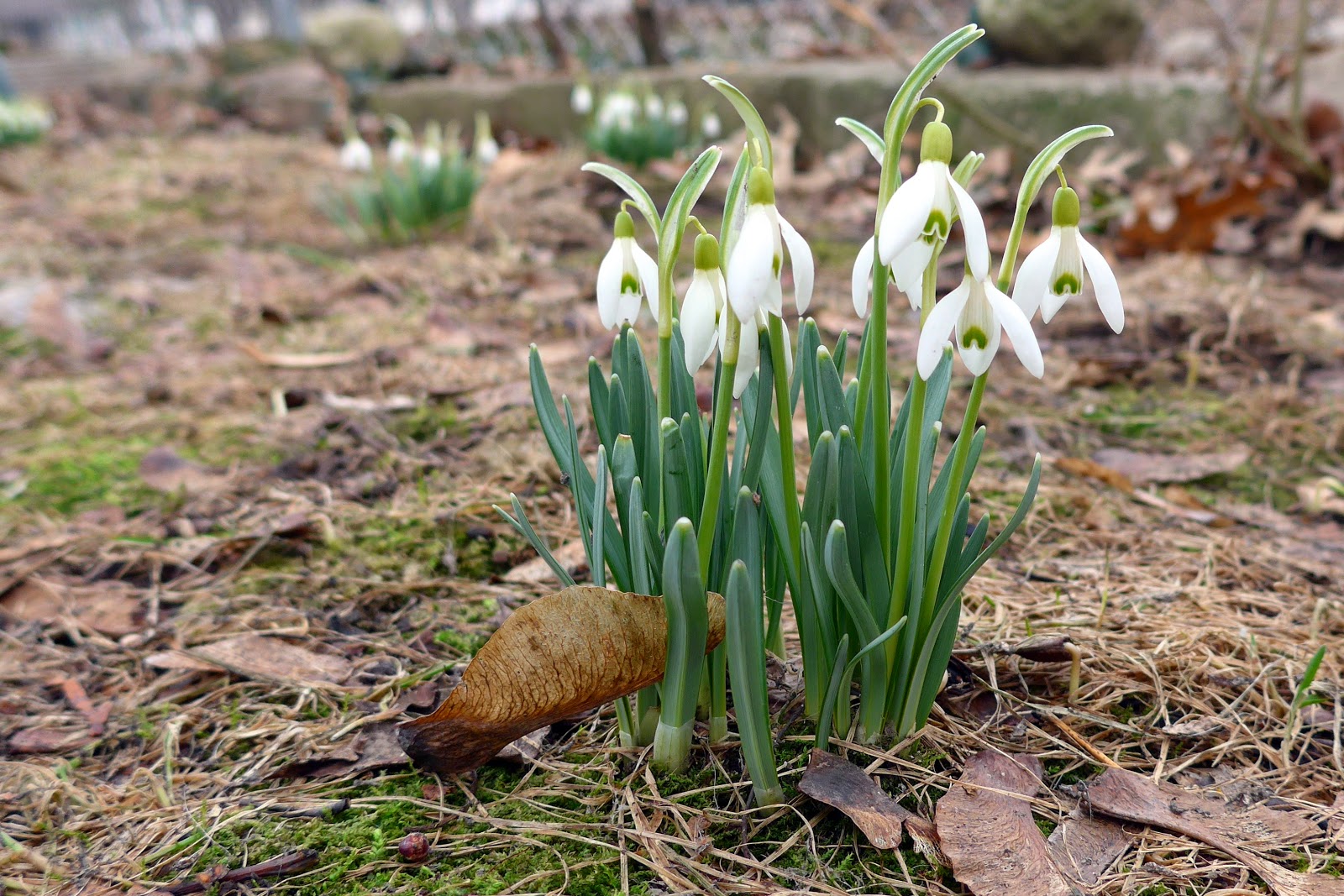
The ice across our street finally melted yesterday and today; the snow pile by the park is slowly shrinking; and there are snowdrops in our yard!


I'm sure there will yet be a tug of war between winter and spring - but eventually, spring will win!

Thursday, February 27, 2014

The Amazing Thing, and Other Books

The Amazing Thing About the Way It Goes, by Stephanie Pearl-McPhee

Last week, I read that Stephanie's new book was being released on March 5. In that same blog entry, she posted her book tour. It seemed there are events scheduled on both the east and west coasts, but nothing here in the Midwest. So, I got online and ordered her book from our local bookstore.

Two days later, I got an email saying the book was in, and I could pick it up at my earliest convenience.

I read that email, and looked at the calendar (which said February 21), and double checked Amazon (where it still claimed the release date was March 5). I wondered if I should point out this little discrepancy to the book store. Then I thought some more, and decided that if they were willing to release the book early, I was willing to read it early.

Having done that, I now encourage you to find and read it at your earliest convenience. This is Stephanie at her best - witty and wise, poking fun at herself, describing her life in essays that had me laughing out loud.

Stephanie's description of learning to use clipless bicycle pedals was hysterical. Her assessment of the writer's group was spot on (and made me feel pleased, and somewhat smug, that I do write for my blog, at least occasionally).

I love how kindly she describes Joe (to my knowledge, Stephanie has never referred to her husband as 'Fang'). She explains the benefits of her powerful imagination (as well as the spectacularly entertaining disasters that her imagination conjures up). Snap is a sweet essay that explains why we should just give in, and smile for the camera.

I read the story about the family skunk just before going to bed, and dreamed that our basement housed families of dogs and cats and raccoons, all living together happily. There was also a cobra in my dream basement; he made me nervous, and I wondered what Stephanie would make of him?!?

Beg, borrow, or buy The Amazing Thing, and enjoy a good read!

Two other books that I've recently finished are The Best American Essays 2013, edited by Cheryl Strayed and Robert Atwan; and The American Way of Eating, by Tracie McMillan.

From the back cover of Essays 2013:
"Each volume's series editor [Robert Atwan] selects notable works from hundreds of magazines, journals, and websites. A special guest editor, a leading writer in the field [Cheryl Strayed], then chooses the best twenty or so pieces to publish."
The essays were essentially short memoirs, stories from the author's perspective. I read them all, enjoyed most of them, and found some incomprehensible. My favorites were those that offered insight into a life not my own: Doyle's His Last Game; Stielstra's Channel B; Schmitt's Sometimes a Romantic Notion; Yoshikawa's My Father's Women; Kerstetter's Triage; Sampsell's I'm Jumping Off the Bridge; and Harvey's The Book of Knowledge.

The American Way of Eating is one of the selections for this year's Reading Together event, sponsored by the Kalamazoo Public Library. McMillan sets out to study our way of growing and distributing food. She works in California farm fields; in Walmart's produce section; and in the kitchen of an Applebee's restaurant. She reports her experiences faithfully, with anecdotes about co-workers and families she meets, with stories from her jobs, and with abundantly researched facts and figures. I did not find it "compulsively readable" or "compelling" (as touted on the back cover). Still, I would recommend it, for the good info and insights it offers.

Wednesday, January 1, 2014

My Story

I remember the horror and concern when Elizabeth Smart was kidnapped from her home. I remember the relief and amazement, nine months later, when she was returned to her family. What really amazed me, in the years that followed, was the sense that she had come through this intact, that she was coping, that she seemed to be living a normal life.

Of course, I only knew what I saw in the media - and I didn't follow closely, and only saw snippets of even that information. But I knew she had founded the Elizabeth Smart Foundation, to prevent and stop predatory crimes. I knew she spoke out on behalf of victims. But I was curious as to how she had managed to cope, apparently, so well.

So, even though I worried a bit about being a voyeur, I wanted to read her story, as told in her memoir My Story (with Christ Stewart). I wanted to see what she herself had to say.

Smart described in detail her nine months with Mitchell and his wife. She did not describe his abuse in detail, except to recount - over and over - "he raped me." She did describe her thoughts - the thoughts of a fourteen-year-old - as she tried to figure out how to survive.

She told of her faith, and how this helped her endure. She told of several miracles that encouraged her. And she told of persuading Mitchell to return to Utah, from California, knowing that if anyone was still looking for her, it would be in Salt Lake City.

I think, ultimately, that her mother's advice, when Smart finally was home again, was the beginning of her recovery.
Elizabeth, what this man has done is terrible. There aren't any words that are strong enough to describe how wicked and evil he is! He has taken nine months of your life that you will never get back again. But the best punishment you could ever give him is to be happy. To move forward with your life. To do exactly what you want. Because, yes, this will probably go to trial and some kind of sentencing  will be given to him and that wicked woman. But even if that's true, you may never feel like justice has been served or that true restitution has been made.

But you don't need to worry about that. At the end of the day, God is our ultimate judge. He will make up to you every pain and loss that you have suffered. And if it turns out that these wicked people are not punished here on Earth, it doesn't matter. His punishments are just. You don't ever have to worry. You don't ever have to even think about them again.

You be happy, Elizabeth. Just be happy. If you go and feel sorry for yourself, or if you dwell on what has happened, if you hold on to your pain, that is allowing him to steal more of your life away. So don't you do that! Don't you let him! There is no way that he deserves that. Not one more second of your life. You keep every second for yourself. You keep them and be happy. God will take care of the rest.
Smart followed that advice. She hung on to gratitude and faith, and let the pain and anger and hurt go. She wrote
. . . I decided very early that I only had one life and that I wasn't going to waste it.

As of this writing, I am twenty-five years old. I have been alive for 307 months. Nine of those months were pretty terrible. But 298 of those months have been very good. I have been happy. I have been very blessed. Who knows how many more months I have to live? But even if I died tomorrow, nine out of 307 seems like pretty good odds.
Those nine months were, as Smart said, pretty terrible. But what Smart has done since then is pretty amazing, too.


Tuesday, December 31, 2013

Almost Amish

Almost Amish: One Woman’s Quest for a Slower, Simpler, More Sustainable Life, by Nancy Sleeth.

I read this book last October, for our book group*. I wrote this review at the same time, but for some reason, never posted it. Oops.

Overall, I thought Sleeth had good ideas, although I thought she had to stretch her analogy pretty far, to link them to an Amish lifestyle.

She introduced ten general principles that lead to her "slower, simpler, more sustainable life:"

1.    Homes are simple, uncluttered, and clean: the outside reflects the inside.
2.    Technology serves as a tool and does not rule as a master.
3.    Saving more and spending less bring financial peace.
4.    Time spent in God’s creation reveals the face of God.
5.    Small and local leads to saner lives.
6.    Service to others reduces loneliness and isolation.
7.    The only true security comes from God.
8.    Knowing neighbors and supporting local businesses build community.
9.    Family ties are lifelong; they change but never cease.
10.    Faith life and way of life are inseparable.

In the chapter on homes, she emphasized that “No big house or yard care means more time for family, friends, and God.” She also talked about the importance of hospitality - which is easier if you aren't stressed about all the aspects of keeping a home running. She pointed out that soup makes a great meal, and is easy to prepare and serve - that idea has stuck in this non-cook's head!

She made an interesting statement about technology:
According to the Bureau of Labor Statistics, the average American spends just nine minutes per day in religious and spiritual activities. This disparity between how much time with technology and how much time we spend with God says much about our priorities. I think it indicates that technology is supplanting God in our hearts and affections.  We are pursuing technology with an abandon and intensity that should be reserved for God alone.
If true (she didn't cite references for her stats), this is very telling. (I know that I spend a disproportionate amount of time on social media.)

In her chapter on simplicity, she stated, “Simplicity involves cutting back on two major kinds of stuff – the kind that fills our houses and the kind that fills our calendars.” We all struggle with this, and our book group spent a good bit of time discussing the challenges inherent in this effort.

Regarding service (chapter 6), she wrote
[God] wants us to serve him with a glad heart, not because he is lacking anything, but because the very act of getting outside our selfish, small concerns enriches us. Service is the agent through which we act out our love for God and for one another. Serve God: serve your neighbor. In doing one, we are doing the other.
This made me think of Mosiah 2:17: "when ye are in the service of your fellow beings ye are only in the service of your God."

I think that's the most important side effect of simplifying our lives - we have more time and energy to serve others. Certainly the principles that Sleeth shares can help us in this endeavor.


* We chuckled when one member of our book group confessed that she had read the wrong book. She had grabbed it quickly from the library, without looking closely, and read a book with the same title, but by a different author (Kathryn Cushman). It was a novel about two sisters participating in a reality TV show, and not at all what our reader was expecting. Oops!

Sunday, November 10, 2013

Dogs and Small Boys

My nephew and niece, Jon and Laura, are moving soon, from Chicago to Virginia. This means that our two to two-and-a-half hour trip to visit them will become a ten to eleven hour trip instead. We are thrilled that they have found gainful employment, but we are sad that they'll be so far away.

Much to our delight, they came for a visit on Friday. We ate some lunch (Jon was starving), and played in the park (I think the park is the highlight for the little guys). Then we all headed to the fairground, where there are dog shows all weekend. Friday's show was sponsored by the Grand Rapids Kennel Club.

When going to a dog show, I highly recommend taking along several small boys. It will shorten your stay - we only made it through a couple Best in Group judgings - but the handlers we met were delighted to talk with M and C, and help them pet the dogs. (Admittedly, you should try to find several small boys who are also exceedingly charming.)

When we watched the hound group (my favorite, because: Beagles!), we were positioned at the far end of the ring from the actual judging. So the handlers were pretty relaxed as they came our way, and they chatted with the boys, and showed off their dogs a bit.

Here are C and one of the dogs (unfortunately, I have no great pictures of M):

Mutual admiration: C and a Saluki
These photos (also from the hound group) were taken without flash, and therefore are a bit shaky.

Elkhound, adoring his handler
(and, I suspect, waiting
for a treat)

Petit Basset Griffon Vendéen (PBGV),
just being cute

Beagles! Large (15") and Small (13")
We saw dogs being groomed, and dogs that were just hanging out. I met my first Leonberger - a good looking (albeit very large) fellow. Lots of Corgis wandering around - it must have been near time for their judging. We saw some tiny little Chihuahuas heading out, and many other breeds, all of which M pointed out with glee. (It was delightful to have M take my hand and drag me off to see some dog or other.)

We headed back home, where - surprise! - we went to the park again. After dinner, we played Farkle, and had Laura and Jon show us (again - Joyce had taught us last summer) how to play Liar's Dice. I clearly was at a disadvantage - I could not remember the rules at all (I'm sure everyone was tired of my repeatedly asking for yet another explanation, although everyone was unfailingly polite). I definitely had no clue regarding strategy! Ah well.

Speaking of dogs... I recently read Mary Oliver's Dog Songs. I generally enjoy Mary Oliver's poetry, and (as any who have read my blog will know) I am somewhat fond of dogs. Accordingly, I thought this would be the perfect book - but not so. Shortly after starting this book, I heard the quote from Oscar Wilde, "All bad poetry springs from genuine feeling," and immediately thought of the Oliver book. It is clear she genuinely loves her dogs, but the poetry is, for the most part, below the quality I am used to seeing in her work.

Still, there were some that I liked. I first heard this one on The Writer's Almanac, back in September.
How It Is with Us, and How It Is with Them
by Mary Oliver

We become religious,
then we turn from it,
then we are in need and maybe we turn back.
We turn to making money,
then we turn to the moral life,
then we think about money again.
We meet wonderful people, but lose them
     in our busyness.
We're, as the saying goes, all over the place.
Steadfastness, it seems,
is more about dogs than about us.
One of the reasons we love them so much.
I did like the pencil drawings in the book; my favorite is the cover photo of Ben, who reminds me of our Bonnie.

Bonnie, for whom life is
all about the smells

Thursday, September 26, 2013

The Great Gatsby

The other night, I finished F. Scott Fitzgerald's The Great Gatsby, just in time for our book group discussion.

Somehow, I managed to reach adulthood without reading this classic of American literature. I remember watching the Robert Redford movie, back in 1974 (memorable because it is the only time I can remember our going out to a movie together, just me and Mom, and memorable because: Robert Redford!!). Friends assured me that I must have read it in high school, but as soon as I started reading, I knew this wasn't the case.

In our book group, we discussed likeable female characters (none), and likeable male characters (Nick? Gatsby?). We discussed symbols of hope and the lifestyles of the bored rich and the nouveau rich. We discussed societal classes, and wandered into our struggles with religious faith (how did we make that leap?!?).

Here, I will simply say that that this book held me spellbound. Thanks to Mr. Redford, I knew how things were going to end, but the writing and the detail, and the portrayal of Gatsby's hope, growing and then fading to nothing, were splendid.

How could I not love lines like this?
The wind had blown off, leaving a loud, bright night, with wings beating in the trees and a persistent organ sound as the full bellows of the earth blew the frogs full of life.
Referring to the green light at the end of Daisy's dock - the light that Gatsby had watched, as he nourished his hope for a life with Daisy - Fitzgerald evoked a sense of loss.
Possibly it had occurred to him that the colossal significance of that light had now vanished forever. Compared to the great distance that had separated him from Daisy it had seemed very near to her, almost touching her. It had seemed as close as a star to the moon. Now it was again a green light on a dock. His count of enchanted objects had diminished by one.
Nick reported the difference between Gatsby and the Buchanans, and people like them. He saw how Gatsby had forged and clung to his dream, and how easily Daisy entered and then abandoned that same dream.
They were careless people, Tom and Daisy - they smashed up things and creatures and then retreated back into their money or their vast carelessness, or whatever it was that kept them together, and let other people clean up the mess they had made...
Tragic and sad and haunting, and still with a glimmer of hope, however futile:
Gatsby believed in the green light, the orgastic future that year by year recedes before us. It eluded us then, but that's no matter – to-morrow we will run faster, stretch out our arms farther... And one fine morning –

So we beat on, boats against the current, borne back ceaselessly into the past.

Sunday, September 22, 2013

Books (Part 3)

This post will finally satisfy my obsessive need to record every book I've read of late, and allow me to finally claim that I am Caught Up (as long as we don't consider the book I just finished last night...). I think it's been a year since I read some of these books; I don't regret reading them, but they weren't particularly compelling or spectacular. Of course, your mileage may vary!

The Submission by Amy Waldman

This was Kalamazoo's Reading Together book for 2013, and one of my book group's choices as well. The book opens with a committee's choosing the design for a memorial to those killed on 9/11. After making their selection, they learn that the designer is Mohammed Khan, an American Muslim.

The rest of the book addresses the chaos and conflict that arise: can we remember the dead with a memorial designed by a Muslim? The book had great potential, and indeed, generated excellent discussion in our group. Still, I found the writing to be sub-standard, and the storyline contrived, so, for me at least, it was not a memorable read.

Paris, My Sweet: A Year in the City of Light (and Dark Chocolate), by Amy Thomas

This was a fun read - especially if you plan to visit Paris, and want to know the best places to buy sweets. Thomas travels to Paris to work writing copy for Louis Vuitton, and shares with us her sweet culinary adventures, as she savors the chocolates and pastries throughout the city.

Imperfect: An Improbable Life,by Jim Abbott

By no means a literary masterpiece, this was an enjoyable memoir. When Abbott was born, one of his arms was a mere stump. His young parents managed to hold things together, and raised him to figure things out for himself - so he figured out how to be a major league baseball pitcher.

I liked his willingness, whatever else was going on, to talk to his young fans, with similar physical challenges, and assure them that they, too, could choose their own future. (And, what's not to like about a one-handed pitcher describing his own no-hitter?)

An Invisible Thread: The True Story of an 11-Year-Old Panhandler, a Busy Sales Executive, and an Unlikely Meeting with Destiny, by Laura Schroff.

This was an easy read, about the remarkable relationship between Laura (a sales exec) and Maurice (an eleven-year-old panhandler). They met nearly every week, for years, and built a friendship that spanned decades. It was a remarkable commitment on Laura's part, and made me wonder if I would do the same.

The Sweetness at the Bottom of the Pie, by Alan Bradley

This mystery featured a precocious eleven-year old scientist / detective, in a small English town. It was a quick, enjoyable read (the first in a series, although I haven't read any of the others).

The Hunger Games, Catching Fire, and Mockingjay (The Hunger Games, books 1-3), by Suzanne Collins

The first of these books was excellent, if a bit disturbing. In Katniss's world, the Capitol controls the outlying districts by holding the annual Hunger Games competition, in which one boy and one girl from each district are sent to compete - to kill or be killed. Katniss is chosen as a competitor, and we see everything from her perspective.

Collins created an astonishing, amazing world, and that first game was gripping. Alas, books 2 and 3 were nowhere near as satisfying. They seemed rushed, and especially the third had pieces that just made no sense to me. I'd recommend the first, and then you can ask someone to recap the remaining books for you, and save you the effort of reading them.

Defending Jacob, by William Landay

A high school student is killed, and the town's prosecuting attorney begins to suspect that his own son, Jacob, might be the murderer. I thought this would be an interesting book, but it was only so-so. Jacob's behavior was creepy and disturbing, and his father seemed to make one bad choice after another. I don't think I'd recommend this one.

(It occurs to me that perhaps the psychological thriller genre is one that I should avoid.)

The City of Ember, by Jeanne DuPrau

This is the story of a city inside a cave. The residents have no memory of any other life, and the infrastructure of their society is crumbling. Two twelve-year-olds take on the challenge of solving a decades-old puzzle, and finding a way out of their city, and to a new life. I recommend this one for the middle-school audience it was written for.

Tuesday, September 10, 2013

Books (Part 2)

Here I go, with round two in my effort to catch up on my book reports. Just typing that phrase - "book report" - reminded me of writing book reports in fifth grade. We drew book covers, and tacked them, along with our reports, to the bulletin board. I remember writing a report about Huckleberry Finn (or maybe Tom Sawyer), trying to write a witticism, failing completely. Actually, it seems that a lot of my witticisms failed that year. Maybe Mrs. Scott just had no sense of whimsy...

I just googled what should be in a book report. The site I stumbled on (for kids) suggests including setting; characters; story; and your thoughts. Hm. I think I often fall short of that goal; I know that these fast and furious reviews are falling short - and I'm pretty sure I can live with that.

The Faith Club: A Muslim, A Christian, A Jew--Three Women Search for Understanding, by Ranya Idliby, Suzanne Oliver, and Priscilla Warner

Actually, this book deserves a serious review, but, it's been sitting on my table for months, and I think this is going to be as good as it gets. If you read no further, know that this book is worth reading.

After September 11, three women came together to write a children's book that would highlight connections between their faiths - Islam, Christianity, and Judaism. They quickly realized that they had much to learn about each other, each other's faiths, and even their own faiths. This memoir followed their shared discussions, their crises of faith, their spiritual growth, and their deepening friendship. It was not a quick read, but it was interesting and informative (I was happy to stumble across a copy at the library's used book store, so I could stop renewing my borrowed copy).

Not only do the women learn about each other's faith, but they find their own understanding deepening. For instance, Priscilla struggled with anxiety, and the events of 9/11 only made it worse. She told of a family trip during which she visited an exhibit of paintings by the Canadian artist Emily Carr.
On the wall of one room, a plaque described the era in which her work was completed, amid the chaos of two World Wars and the Great Depression."The papers are full of horrible horrors," wrote Emily Carr. "And the earth is so lovely."

The earth is indeed lovely, I realized. Including New York city.

And so I decided to take a leap of faith. Life is, after all, a series of leaps of faith. Falling in love and believing that I will grow old with my husband is a leap. Losing a parent and believing I will recover is a leap. Giving birth to children and letting go as they grow, hoping they will lead safe, happy lives is a leap. Living in a world of chaos, believing good will prevail over evil, is a leap.
Ranya not only shared her Islam faith with Priscilla and Suzanne, but worked to find herself a place of comfort in her faith. She observed, "... read in its true spirit, freed from political agendas and liberated from its service to the flawed human heart, Islam, I had come to learn, could be a beacon for true enlightenment, progress, development, and security. Moreover, if Islam regained that voice, it would help to disarm those radical groups who abuse the Quran and interpret it in a way that fits their own political agenda and violent designs."

As I read this book, I remembered an experience I had, a month or so after 9/11. A friend from church knew a Muslim woman, through shared events at their daughters' school. The two of them arranged for  women from both our faiths to meet for lunch one day. We spent some time learning basic principles from each faith - finding much in common - and then mingled together for a potluck lunch. I was so grateful for that chance to reinforce my understanding that there is good in all of us - that it is better to include than to exclude - that we are more alike than we are different.

This book, to a great extent, conveyed the same message.

The End of Your Life Book Club, by Will Schwalbe

Schwalbe's mother is dying of cancer, and as he waits with her in doctors' waiting rooms, or visits her at home, they talk about books. He writes about those conversations, and about the books they shared (many of which were subsequently added to my Goodreads list). He mixes in memories of his mother and his family - both their experiences during that period, and while growing up. I came away wishing I had known her - she seemed to be a friendly, caring, involved woman.

I like this anecdote illustrating the significance of books in his family:
There was one sure way to avoid being assigned an impromptu chore in our house – be it taking out the trash or cleaning your room – and that was to have your face buried in a book. Like churches during the Middle Ages, books conferred instant sanctuary. Once you entered one, you couldn’t be disturbed. They didn’t give you immunity from prosecution if you’d done something wrong – just a temporary reprieve. But we quickly learned you had to both look and be completely engrossed – just flipping pages didn’t count.
No life lessons here - just an enjoyable peek into Schwalbe's family, and their bookshelves.

Monday, September 9, 2013

Books (Part 1)

When I started this blog, I planned to include brief reviews of books, as I read them. This has turned out to be more challenging than I imagined. I recently looked in old posts for some of these reviews, and - gasp - they were not there. In fact, I came up with a rather longish list of books that had gone unmentioned.

I'm trying to remedy that with several brief blog posts, containing even briefer reviews. This first batch contains several favorites.

The Unlikely Pilgrimage of Harold Fry, by Rachel Joyce

I just finished Joyce's book the other day; it was delicious.

One day, Harold Fry receives a letter from an old acquaintance, Queenie Hennessy, telling him that she is dying. Harold writes a quick response and walks to town to mail it, but instead keeps walking (both to his and his wife Maureen's surprise). He simply puts one foot in front of the other, walking without any sort of plan, other than his goal to reach Queenie (some 600-miles north) before she dies. He figures things out as he goes, and spends the miles thinking about Maureen, and his son David, and his friend Queenie (and about blisters). He ponders moments from his past and considers the world around him. He talks with strangers, who willingly help him toward his goal (granted, some of them are a bit off-kilter). Ultimately, he opens his eyes to the truth in his own life, and to what really matters, and exchanges his pride for happiness.

My sister recommended this to me, and I recommend it to you - it left me feeling quite happy and content.

The Book Thief, by Markus Zusak

This is a beautiful book, about how we live, and also a bit about death. The Hubermann family face the challenge of living in a small German town during World War II, and it is a joy to see how they rise to the occasion. At the same time, Death talks about his job, carrying souls away from their dead bodies. A brief excerpt from Death's diary:
On June 23, 1942, there was a group of French Jews in a German prison, on Polish soil. The first person I took was close to the door, his mind racing, then reduced to pacing, then slowing down, slowing down. . . .
Please believe me when I tell you that I picked up each soul that day as if it were newly born. I even kissed a few weary, poisoned cheeks. I listened to their last, gasping cries. Their vanishing words. I watched their love visions and freed them from their fear.

I took them all away, and if ever there was a time I needed distraction, this was it. In complete desolation, I looked at the world above. I watched the sky as it turned from silver to gray to the color of rain. Even the clouds were trying to get away.

Sometimes I imagined how everything looked above those clouds, knowing without question that the sun was blond, and the endless atmosphere was a giant blue eye. They were French, they were Jews, and they were you.
The writing is lyrical and moving. This is one of my very favorite books, I think. I just read that the movie version comes out in November. It is hard to believe they can do the book justice; my little review certainly hasn't done it justice. We will see...

The Beginner's Goodbye, and The Accidental Tourist, by Anne Tyler

I love Anne Tyler's books, and these two did not disappoint. Of the two, The Accidental Tourist is my current favorite (and so I'm going to ignore The Beginner's Goodbye, for now; you can read a review at the link above). Macon Leary, a travel writer, hates to travel. Frankly, he hates anything that disrupts his routine. But when his wife leaves him, a year after their son is killed, his routine is destroyed. Tyler guides us, with humor and kindness, through Leary's life as he moves back in with his unusual siblings, hires the quirky Muriel to train his dog, and wonders if he could ever make a decision for himself. This book just makes me smile.

The Accidental Tourist was made into a movie in 1988 - this is not a recent book! - and they did a nice job with it.

*  *  *

There. Three down, and some more to go. It's a start.

Tuesday, August 20, 2013

Mr. Penumbra's 24-Hour Bookstore

Robin Sloan's latest novel, Mr. Penumbra's 24-Hour Bookstore, is a winner. It is not classic literature, it is not a brilliant mystery, it is not a suspenseful thriller.

It is simply fun.

Clay Jannon, looking for work, stumbles into a job working the night shift at Mr. Penumbra's 24-Hour Bookstore. It doesn't take him long to recognize that this is not your standard bookstore - the stock is limited, the clientele few and far between. This doesn't consider, of course, the unusual books in the back part of the store, and the unusual customers who show up to quickly exchange one unreadable book for another.

Clay is determined to figure out what's up. He calls on his roommate's creative skills and his girlfriend's Google connections. He uses data visualizations and cardboard scanners. He calls in favors from a childhood friend who has become a wealthy entrepreneur. He learns of an ancient fellowship, and meets its quirky members. He turns to an archaeologist and the curator of a knitting museum (!) to locate missing artifacts.

And, with a mix of technology and friendship and books, he solves the puzzle.

There are flaws in some of the logic, and the story requires a few leaps of faith, but this book was a wonderful romp, which I thoroughly enjoyed. The puzzle's solution is lovely - but I don't want to spoil your read, so I'll keep that to myself.

Enjoy! Festina Lente!

Traveling Mercies: Some Thoughts on Faith

I thought I was doing a good job of sharing, via this blog, the books I've read. Recently, however, I've been looking for my thoughts on books I've read, and those thoughts are not to be found. Either my blog is eating them, leaving no trace (which, admittedly, is unlikely); or I have put off sharing the books until they've completely fallen off my radar.

So, I'm going to quickly share two books I've just finished, before they disappear into the ether that is my brain - one in this post, the other in a post that I hope will be written... soon.

Anne Lamott's Traveling Mercies: Some Thoughts on Faith describes, in a series of essays, Lamott's path to God. There was nothing earth-shattering or deeply profound, but I enjoyed her writing, her stark experience, her insights.

At one point, she describes why she (a single mother) makes her son go to church with her, and I think this describes her own reasons for going:
The main reason is that I want to give him what I found in the world, which is to say a path and a little light to see by. Most of the people I know who have what I want - which is to say, purpose, heart, balance, gratitude, joy - are people with a deep sense of spirituality. They are people in community, who pray, or practice their faith; they are Buddhists, Jews, Christians - people banding together to work on themselves and for human rights. They follow a brighter light than the glimmer of their own candle; they are part of something beautiful. I saw something once from the Jewish Theological Seminary that said, " A human life is like a single letter of the alphabet. It can be meaningless. Or it can be a part of a great meaning."
She talks about things breaking - "hearts, health, confidence" - and shares words from her preacher:
Our preacher Veronica said recently that this is life's nature: that lives and hearts get broken - those of people we love, those of people we'll never meet. She said that the world sometimes feels like the waiting room of the emergency ward and that we who are more or less OK for now need to take the tenderest possible care of the more wounded people in the waiting room, until the healer comes. You sit with people, she said, you bring them juice and graham crackers
(which made me think of Alma's teaching that we be willing to bear one another’s burdens, that they may be light, and that we be willing to mourn with those that mourn, and willing to comfort those that stand in need of comfort).

Lamott shares Raymond Carver's poem, Late Fragment, in her chapter on belonging to a community:
And did you get what
you wanted from this life even so?
I did.
And what did you want?
To call myself beloved, to feel myself
beloved on the earth.
We take many paths to find our community, and our God, and I don't think one is more right than another. Lamott writes about the many mistakes and bad choices she's made in life, and about the losses she's experienced. And then she celebrates, not just being beloved by her community of faith, but by her God:
The mystery of God's love as I understand it is that God loves the man who was being mean to his dog just as much as he loves babies; God loves Susan Smith, who drowned her two sons, as much as he loves Desmond Tutu. And he loved her just as much while she was releasing the handbrake of her car that sent her boys into the river as he did when she first nursed them. So of course he loves old ordinary me, even or especially at my most scared and petty and mean and obsessive. Loves me; chooses me.
The title of her book comes from what the old people at her church said when anyone left for a while: "Traveling mercies: love the journey, God is with you, come home safe and sound." Her book, really, describes her journey, which leads her, finally, home, safe and sound.

Wednesday, July 31, 2013

Sold

A while ago, I read Kristof and WuDunn's book, Half the Sky, detailing the oppression of women.

I've seen the movie Water, which tells of Hindu women living in an ashram for widows, including the child Chuyia, and of their mistreatment.

Just the other day, I read of an FBI sweep that rescued more than 100 children from a sex trafficking ring, including 10 here in Michigan.

I am aware of the plight of many women in our world, both here in the U.S. and abroad. But nothing I've read or seen touched me as much as Patricia McCormick's book, Sold. Although it is written for teen-age readers, I found it compelling and moving.

The narrator is Lakshmi, a thirteen-year-old girl living in the mountains of Nepal with her mother, stepfather, and baby brother. She describes the hardship and poverty of their life, the small joys and the sadness. She tells of her goat Tali, and of the cucumbers she is growing (and which she has named). She tells of the four babies born between her and her brother. She describes drought and hunger, and then the falling of too much rain.
When the night rain soaks the ground past the soaking point, when the earthen walls around the paddy melt away, when the rice plants are sucked out of the earth one by one and washed down the slope, there should be a sound, a noise announcing that something is terribly wrong.

Instead there is a ghostly hush that tells us we have lost everything.
Lakshmi's stepfather arranges for her to go to the city, where she will work as a maid. She looks forward to being able to send money home to her family, just as her friend Gita has done. She describes her journey, and the amazing sights and sounds and smells.

But of course, as I read, I knew where she was really heading, and I dreaded the fate that awaited her. She fights and resists that fate, but eventually succumbs to the inevitable.
I cannot tell which of the things they do to me are real,
and which are nightmares.

I decide to think that it is all a nightmare.
Because if what is happening is real,
it is unbearable.
Lakshmi's mother had taught her, "Simply to endure is to triumph."  The other girls teach her how to get along in this new life, she learns some Hindu words from a young boy, and she continues to dream of paying off her debt so she can return home. One day, the boy gives her a pencil.
It is shiny yellow and it smells of
lead and rubber. And possibility.

I have been beaten here,
locked away,
violated a hundred times
and a hundred times more.
I have been starved
and cheated,
tricked
and disgraced.

How odd it is that I am undone by the simple kindness
of a small boy with a yellow pencil.
As I read, I believed this would end well, that Lakshmi would be one of those to escape the brothel and its horrors. It heartened me to read that she herself still had the drive to get away:
I know something else as well. I know that I would endure a
hundred punishments to be free of this place.
On her web page, McCormick wrote, "It was important to remember that, in even the grimmest of situations, there is kindness as well as cruelty, terror as well as boredom, and even, surprising as it may seem, humor." Her excellent book conveyed all this.

Sunday, June 16, 2013

The World's Strongest Librarian

I don't remember where I heard about Josh Hanagarne's book, The World's Strongest Librarian, but it piqued my interest: a Mormon librarian, who lifts weights and has Tourette Syndrome.

My quick assessment? Hanagarne's memoir gets a solid thumbs up. It was well-written and interesting, and made me care about Hanagarne and his family. In the process, I learned a little about about life with Tourette's.

Hanagarne's memoir mixes stories from his job as a librarian with stories of his life: his loving parents; his efforts to control his Tourette's; his experiences as a Mormon missionary; his strength training; his repeatedly interrupted university studies; his search for his place in this world.

I was a bit worried about the Mormon aspects of Josh's life. I remembered from the review I'd heard that he is no longer active in the LDS church, and I worried that the book would have an anti-Mormon slant. But this wasn't the case at all. As he wrote about his life, his church participation was a part of that life, and he wrote positively about those experiences. Ultimately, he simply didn't have the same belief and knowledge as his family, and so stepped back. He wrote
When people tell me. . . that the church is a controlling, greedy, sinister monster that's only interested in brainwashing people and subjugating women, I say, "I don't know that church, but I can understand why you'd have a problem with the church's history." I know happy, generous people. I know my compassionate bishop. I don't see rubes and sheep. I'm way too ignorant and fallible and unsure to sneer at other people who are just trying to live the best way they know how. I see people who want the world to be better than it is and who are willing to work for it.

I just can't work at it in the same way they do anymore. I can't trust my emotions as confidently as they trust theirs. . . If there's a personal God, I have to believe that he knows my heart, and why I have to do what I'm doing right now. Why I have to live according to what makes sense to me, and not according to what is sacred to others.
Hanagarne eventually becomes a librarian, and writes eloquently about the need for and benefits from libraries (he works at the Salt Lake City Public Library). Talking about patrons of different classes and races and such, and how they struggle to get along, he writes
 . . . while we may never find specific, actionable solutions, a good library's existence is a potential step forward for a community. If hate and fear have ignorance at their core, maybe the library can curb their effects, if only by offering ideas and neutrality. It's a safe place to explore, to meet with other minds, to touch other centuries, religions, races, and learn what you truly think about the world.
He sees libraries, and the items that circulate from libraries, as leading
to members of the community gathering in the same place. People who might never lay eyes on one another elsewhere. In this digital era when human contact sometimes feels quaint to me, this is significant. If libraries themselves become quaint because they house physical objects and require personal interaction at times, so be it. For that reason, I believe physical libraries always need to exist in some form.
What I liked most about this memoir, I think, is that it seems so honest. Hanagarne is simply a nice guy, with a terrible affliction. He never really overcomes his Tourette's, but he finds peace in his life just the same. At one point, he talks about what he'll tell his son about his attitude toward the church. It comes across a recap of what really matters to him - and Tourette's is not a part of that recap:
What I'll tell Max is that I love his mom, his grandparents, and his aunts and uncles and cousins more than anything. I'll tell him that they are my life, and they are a life worth living. When he asks what I believe, I'll tell him that I do believe in many of the tenets of the church:

Be kind and compassionate.

Serve others.

You are responsible for your actions and should be accountable for them, if only to yourself. . . .

Don't lie, kill, steal, or cheat.

Family is the greatest joy on earth.

Study the best books.

Be accountable to yourself. . . .

I'll tell him that I was the luckiest, happiest kid in the world. I will tell him that there are no words I can use to describe how much I love my parents, and how grateful I will always be for them.
Go find yourself a copy of his book, and enjoy!

Tuesday, May 28, 2013

Tattoos on the Heart

Gregory Boyle was interviewed a few months ago, on an episode of On Being. Here is Krista Tippett's introduction from that show:  "A Jesuit priest famous for his gang intervention programs in Los Angeles, Fr. Greg Boyle makes winsome connections between service and delight, and compassion and awe. He heads Homeboy Industries, which employs former gang members in a constellation of businesses. This is not work of helping, he says, but of finding kinship. The point of Christian service, as he lives it, is about 'our common calling to delight in one another.'

(By the way - net proceeds from this book are donated to Homeboy Industries.)

Intrigued by the interview, I read Boyle's memoir, Tattoos on the Heart: The Power of Boundless Compassion. He shares stories and experiences, and again and again shares his belief in God's compassion, encouraging us to develop that same compassion. He writes in a comfortable, sitting-and-chatting style, encouraging the reader to consider Jesus' approach:
Jesus says if you love those who love you, big wow (which I believe is the original Greek). He doesn't suggest that we cease to love those who love us when he nudges us to love our enemies. Nor does Jesus think the harder thing is the better thing. He knows it's just the harder thing. But to love the enemy and to find some spaciousness for the victimizer, as well as the victim, resembles more the expansive compassion of God. That's why you do it.

To be in the world who God is.

Here is what we seek: a compassion that can stand in awe at what the poor have to carry rather than stand in judgment at how they carry it.
He encourages us to not merely serve others, but to develop a oneness with them. This reminds me of a blog post that talked about the divisiveness that occurs when we separate ourselves into the 'in-group' and the 'out-group.'
Jesus and Petra [a woman who welcomed 'wetbacks' in their community] are on the same page here. They chose a oneness in kinship and a willingness to live in others' hearts. Jesus was not a man for others. He was one with others. There is a world of difference in that. Jesus didn't seek the rights of lepers. He touched the leper even before he got around to curing him. He didn't champion the cause of the outcast. He was the outcast. He didn't fight for improved conditions for the prisoner. He simply said, "I was in prison."
Continuing the idea of inclusion versus exclusion, Boyle writes,
Scripture scholars contend that the original language of the Beatitudes should not be rendered as "Blessed are the single-hearted" or "Blessed are the peacemakers" or "Blessed are those who struggle for justice." Greater precision in translation would say, "You're in the right place if . . . you are single-hearted or work for peace." The Beatitudes is not a spirituality, after all. It's a geography. It tells us where to stand.

Compassion isn't just about feeling the pain of others; it's about bringing them in toward yourself. If we love what God loves, then, in compassion, margins get erased. "Be compassionate as God is compassionate," means the dismantling of barriers that exclude.
In his interview with Krista Tippett, Boyle spoke of our duty to delight. In his memoir he writes,
Dorothy Day loved to quote Ruskin, who urged us all to the "Duty to Delight." It was an admonition, really, to be watchful for the hilarious and the heartwarming, the silly and the sublime. This way will not pass again, and so there is a duty to be mindful of that which delights and keeps joy at the center, distilled from all that happens to us in a day.
Boyle's ideas are lofty, and I'm not sure how to apply them in my daily life, where I talk to co-workers on the phone, and care for our beagle, and hang out with my husband. I'm not immersed in the needs of gang members, as Boyle is, and yet somehow, I need to find a way to connect and serve in the community, and to share in the delight as well.

This is a terrific book; I recommend it without reservation.